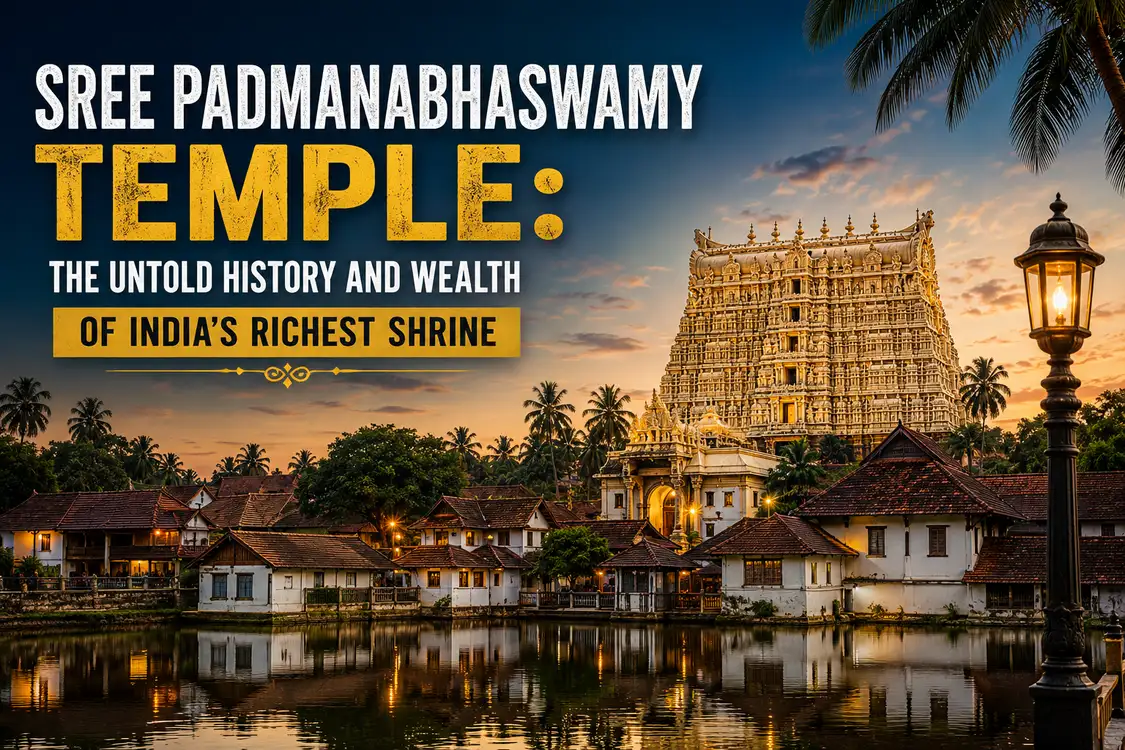
Located in the center of Thiruvananthapuram, the capital of Kerala, the Sree Padmanabhaswamy Temple is a global center of historical intrigue and religious devotion. Dedicated to Lord Vishnu, this monumental structure made international headlines in 2011 when authorities opened its underground vaults, revealing a hoard of gold, diamonds, and ancient artifacts estimated at over $22 billion. But the true value of the Padmanabhaswamy Temple goes far beyond its monetary riches. For history enthusiasts and devotees alike, the temple offers a massive archive of Kerala’s past, having survived centuries of political shifts and cultural changes.
If you are planning a visit, understanding the temple’s roots, its architectural milestones, and the facts surrounding its legendary wealth is essential. Here is a complete overview of the Sree Padmanabhaswamy Temple.
Ancient Origins and Enduring Legends
The exact date the Padmanabhaswamy Temple was built remains unknown, but historical records and ancient literature confirm its existence for over a millennium. The 9th-century Tamil poet-saint Nammalvar composed hymns praising the deity here, proving the shrine was already highly revered during the early medieval period.
According to local Hindu legends, the temple’s location was discovered by a great sage, Vilwamangalam Swamiyar. The sage experienced a vision of Lord Vishnu taking the form of a gargantuan deity reclining on the multi-headed serpent Anantha (also known as Shesha). Awed by the sight, the sage offered a salted unripe mango in a coconut shell to the deity. To this day, salted mango offered in a golden coconut shell remains one of the primary rituals at the temple.
The main idol inside the sanctum sanctorum depicts Lord Vishnu in the “Anantashayana” posture—the eternal sleep of yoga nidra on the cosmic serpent. Uniquely, the massive idol is not carved from a single stone. It is constructed from an ancient amalgam called Katusarkarayogam and contains 12,008 sacred Salagrama stones. These fossilized stones were brought all the way from the banks of the Gandaki River in Nepal, highlighting the extensive spiritual networks of ancient India.
King Marthanda Varma and the Transformation of Travancore
While the temple stood for centuries, it took its current grand form during the 18th century under the rule of King Marthanda Varma, the founder of the modern kingdom of Travancore. After taking the throne in 1729, Marthanda Varma initiated a massive renovation project. He constructed the imposing seven-tier gopuram (entrance tower) in the Dravidian style, blending it with the traditional wood-and-sloping-roof architecture of Kerala.
In January 1750, Marthanda Varma performed an act that cemented the temple’s absolute power. Through a ceremony called Thrippadi Danam, the king donated his entire kingdom and all its wealth to Lord Padmanabhaswamy. The king declared that he and his descendants would rule only as Padmanabha Dasas—servants of the Lord. From that day forward, the deity was the legal ruler of Travancore, and all state revenue was technically the property of the temple.
The Discovery of the Trillion-Rupee Wealth
For generations, rumors circulated about vast treasures hidden beneath the stone floors of the temple. In 2011, the Supreme Court of India ordered a detailed inventory of the temple’s six underground vaults, labeled A through F, following a legal dispute over the temple’s administration.
When investigators opened five of the vaults, they found wealth that surpassed all expectations. The inventory revealed solid gold idols, an 18-foot-long gold chain, sacks of diamonds and precious gems, and coins from the Roman Empire, Venice, and Napoleonic France. The total estimated value of the artifacts was a staggering 1 trillion rupees (around $22 billion USD), instantly confirming the Padmanabhaswamy Temple as the wealthiest religious institution in recorded history.
How did the temple accumulate such massive wealth? Historians point to three main reasons:
- Trade Dominance: Kerala was a global hub for the highly lucrative spice trade, particularly black pepper. Rulers and merchants from across the world brought gold and silver to Kerala, much of which ended up in the temple treasury as taxes or offerings.
- Royal Donations: For centuries, the kings of Travancore and neighboring kingdoms made heavy donations of gold to the deity. Some kings even practiced a ritual of weighing themselves against gold and donating the equivalent amount to the temple.
- Safety from Invasions: Unlike many wealthy temples in northern India that were repeatedly plundered by foreign invaders, Travancore’s geographical location at the southern tip of India kept it insulated. The rulers successfully defended the region from major attacks, meaning the temple’s wealth sat undisturbed for thousands of years.
The Unopened Mystery of Vault B
While five vaults were successfully cataloged, one remains firmly shut: Vault B. The massive door of Vault B is made of heavy iron and wood, adorned with ominous carvings of giant cobras. According to temple priests and local lore, Vault B is guarded by mystical forces, and opening it would bring catastrophic misfortune.
The Supreme Court committee respected the religious sentiments and warnings, leaving Vault B untouched. To this day, what lies behind the serpent-carved doors of Vault B remains one of the greatest mysteries in modern India.
Temple Architecture and Rules for Visitors
The temple is a masterpiece of stone and wood engineering. Its stone corridor features 365 and one-quarter intricately carved granite pillars. The central shrine is viewable through three separate doors: the face and chest of Lord Vishnu are seen through the first door, his midsection and the lotus emerging from his navel through the second, and his feet through the third.
If you are planning to visit, you must strictly follow the temple’s dress code. Men are required to wear a white mundu (dhoti) and leave their upper bodies bare or wear a shawl. Women must wear a sari, long skirt, or a half-sari. Modern clothing like jeans, shorts, and printed shirts are strictly prohibited. In line with the Temple Entry Proclamation, the temple is restricted to those who profess the Hindu faith.
Planning Your Trip: Cochin Airport to Padmanabhaswamy Temple
Thiruvananthapuram is well-connected by air, train, and road. While the city has its own international airport just a few kilometers from the temple, many tourists exploring the wider Kerala circuit choose to drive down from central Kerala.
If you are starting your Kerala tour from Ernakulam or Kochi, the drive from Cochin Airport to Padmanabhaswamy Temple is a highly scenic route along the coastal highway. The distance is roughly 220 kilometers and takes about 5 to 6 hours by road. Booking a reliable cab service ensures you can make comfortable stops along the backwaters of Alappuzha or the beaches of Varkala before reaching the capital city.
For a hassle-free, comfortable, and safe journey, you can easily book your premium taxi through Trips KL Cabs. Whether you need a quick airport transfer or a multi-day Kerala tour package covering the major temples, having a dedicated vehicle allows you to explore the divine history of Sree Padmanabhaswamy Temple at your own pace.
Conclusion
The Sree Padmanabhaswamy Temple is more than just a vault of gold; it is a monument to Kerala’s deeply rooted spiritual traditions, its powerful royal history, and its central role in ancient global trade. From the untouched mysteries of Vault B to the staggering 12,008 Salagrama stones resting in the sanctum, the temple offers an experience unmatched by any other religious site in India. Plan your visit today, respect the ancient customs, and witness the architectural brilliance of the world’s richest shrine.